The "Metro vs. Bus" Paradox…
2/28/20262 min read
Why System Design, Not "Values," Dictates Employee Behavior.
"Contextual compliance" is evident when individuals travel to developed countries too, where they diligently follow civic rules. This isn't a character change, but an adaptation to reliable infrastructure and social norms. Consistent enforcement and clear systems make order the most rational and rewarded choice, proving that environmental design powerfully shapes individual actions.
From an Organizational Design perspective, this serves as a powerful case study in how culture is a byproduct of systems rather than a fixed trait of individuals. Systems with clear design, predictable enforcement, and reliable employee experience foster cooperation, as seen in metro systems, leading to orderly conduct by making compliance the rational choice.The same is true for organisations where employees behaviour is driven by its design & it’s trust system.
Here are three parallel analogies I’m able to draw through an organizational lens:
1. Organizational Design: Infrastructure as Culture
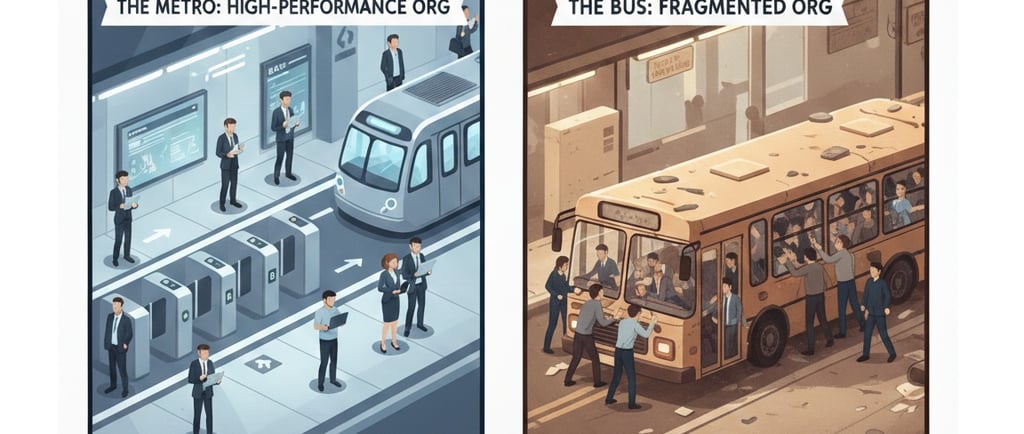
The Survey argues that people aren't "unruly" by nature, they adapt to the system's design. While the Metro uses hard design like turnstiles and marked queues to guide behaviour, the Bus is characterized by ambiguity and "improvisation."
Org Lens- this represents the contrast between Process Engineering and Structural Ambiguity. When employees have clear "scripts" (Job Descriptions, automated workflows, and KPIs), they exhibit high professionalism and compliance without micromanagement—much like Metro commuters. Conversely, in organizations with opaque performance systems, unclear roles or KPIs, employees stop focusing on output and begin "jostling" for visibility and credit, mirroring the "self-help" scramble seen at a bus stop with no fixed rules.
2. Organizational Structure: The Shadow of Authority
The Survey notes the role of a consistent, impersonal "shadow of authority" in Metros-surveillance and predictable enforcement. In the Metro, the rules apply to everyone equally, and the "fine" is non-negotiable.
Org Lens: When systems are unreliable or "broken," employees stop trusting the "queue" (meritocracy) and start "jostling" (office politics/bypassing hierarchy) to ensure their own survival or progress. This represents Organizational Justice. When leadership behaviour and org decisions are demonstrated inconsistently (like a bus driver choosing where to stop), trust collapses. When enforcement is predictable and fair, it creates a "psychologically safe" environment where people feel comfortable being orderly.
3. Employee & Leadership Behaviours: The Logic of Patience
One of the most profound insights is the Reliability-Trust Link. People queue for the Metro because they trust the train will come in three minutes. They scramble for the bus because they fear the next one might not come for more than 30 minutes. If a leader is seemingly unfair (favouritism) or when leaders don’t walk the talk or resources are selectively offered, employees engage in "opportunistic behaviour" to survive.
Org Lens: To foster "inside behaviour" (where employees self-regulate), leadership must provide Predictability. Reliability in rewards, growth, fair compensation, positive enforcement of right behaviours, communication, and resource allocation eliminates the "panic" that leads to toxic workplace competition.
Takeaway
The core takeaway from the Economic Survey 2026 is that design drives disposition. If you want "Metro behavior" from your employees, you cannot simply ask for "better values." You must build the reliability, clear structures, and fair enforcement that make "orderly conduct" the most rational and dignified choice for the individual rather than enforcing it.
Lets Talk
pranay.khadke@inflektionadvisory.com
+91 9740 287 399
© 2026. All rights reserved.